🎹 Master All 12 Major Chords (The Fun & Easy Way!) 🎶

🎹 Master All 12 Major Chords (The Fun & Easy Way!) 🎶
Hey there, piano rockstar! Ready to unlock one of the coolest secrets of the keyboard? 🎩✨ Today, we're diving into major chords—and by the end of this post, you’ll know how to play ALL 12 of them like a total pro. Yes, even the “tricky-looking” ones like F# and Ab! 🚀
But wait—what’s a chord, anyway?
🎯 What Even Is a Major Chord?
Imagine chords as the superhero squad of music. Instead of just one lonely note, you play a team of three powerful notes at once. That’s called a triad, and it makes your music sound rich and full. Major chords are the happy-sounding ones—the ones that feel like sunshine, birthdays, and ice cream. 🍦☀️🎈
🧪 The Magic Formula (Not So Secret, But Super Cool!)
Here’s the deal: there are 12 notes on the piano that we use to build major chords. You can start on any of them—C, D, E, even the funky ones like G# or Bb—and build a major chord using this awesome pattern:
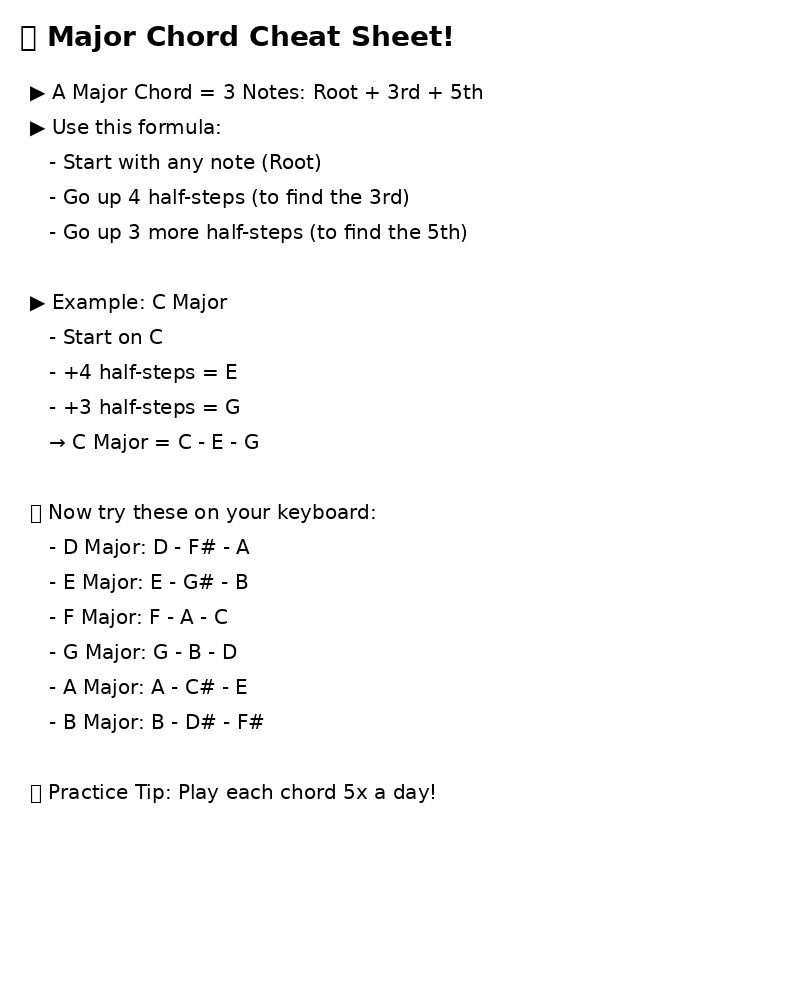
Root → +4 Half Steps → +3 Half Steps
That’s it! Think of it like climbing stairs:
- Start at your root note (that’s your starting note),
- Count up 4 half-steps to find the next note,
- Then count up 3 more half-steps to land on the last note.
💡Example:
- Start on C
- Count up 4 half-steps: you land on E
- Count up 3 more half-steps: you get G
- BOOM! You just played a C major chord (C - E - G). 🎉
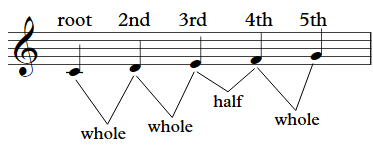
So here is that formula applied to a C major scale:
🏗️ What’s a “Root,” “3rd,” and “5th”?
Don’t worry, it’s not a math test. These are just names for the notes in your chord squad:
- The root is your starting note
- The 3rd is what makes the chord sound happy (in a major chord)
- The 5th gives it power and fullness
Put ‘em all together, and you get that classic major chord sound. 🥁
🕹️ Let’s Get Hands-On
Here’s your mini-challenge:
🎯 Pick any note on the keyboard
🎯 Use the “+4, then +3” trick
🎯 Build your major chord
🎯 Play it loud and proud!
Repeat this for all 12 starting notes and you’ll be mastering major chords like a wizard in no time. 🔮
🧠 Why This Matters
Learning your major chords is like learning the ABCs of music. You’ll use them in:
- Pop songs 🎤
- Jazz tunes 🎷
- Movie soundtracks 🎬
- And even when you make your own music! 🎼
Plus, it’s just super satisfying when your fingers glide into place and—BAM!—you hit that chord like a legend. 😎
Be sure to remember that a major scale contains 7 notes, but in order to build our major chords we only need to be able to find the first 5 notes of the major scale!
Once we've found those first 5 notes, we simply select the root, 3rd, and 5th. Playing these three notes together gives us a major chord!

There is also another way to quickly build a major chord.
- Choose any starting note (the root).
- Count up four half-steps to get to the 3rd.
- Count up three more half-steps to get to the 5th!

🎵 Ready, Set, Chord!
Practicing these chords will make you faster, more confident, and way more musical. Do it every day, and soon you'll be throwing in major chords without even thinking about it.
👉 Wanna take it to the next level? Try playing your favorite song and see if you can figure out what major chords it uses!
🎉 Have fun, and remember: every great musician started with just one note.
You’ve got this. Now go make some musical magic! 💫🎹
Comments (5)
Stuart Currie
Very good article, clearly explained. Thank you Willie.
Michael Lloyd
Does this include the Dominant and the 7th's?
And the sus and augmented and 11th and other odd things that crop up?
Mike
Ericky
i really like your assistance to me.
it is very helpful and interested.
thank u so much
Ralph C May Jr
Good Morning,
Thank you for this information on Chords.
I am presently studying the Circle of fifths and practicing the major and minor scales.
You might consider me as an elderly beginner on the piano.
Practice time is roughly 2 hours each day at 15 to 20 minute intervals.
Your assistance is appreciated. I am studying on my own, and have questions from time to time.
Again, many thanks for the info on Chords
JoAnn
Thank you🎶🎶🎶